Why Nutrition Matters Pre and Post Surgery

Poor nutritional status is an independent risk factor for post-operative complications, making perioperative nutrition an essential component of surgical care.1,2


Nutritional Preparation as a Component of Pre- and Post-Surgical Care

Patients who are well nourished before surgery are better placed to recover. Identifying and addressing nutritional risk pre-operatively is a key component of surgical care.2,4,5

When dietary intake does not meet requirements, pre-operative oral nutritional supplements (ONS) may help maintain nutritional status and support the body's capacity to heal.2,4,5

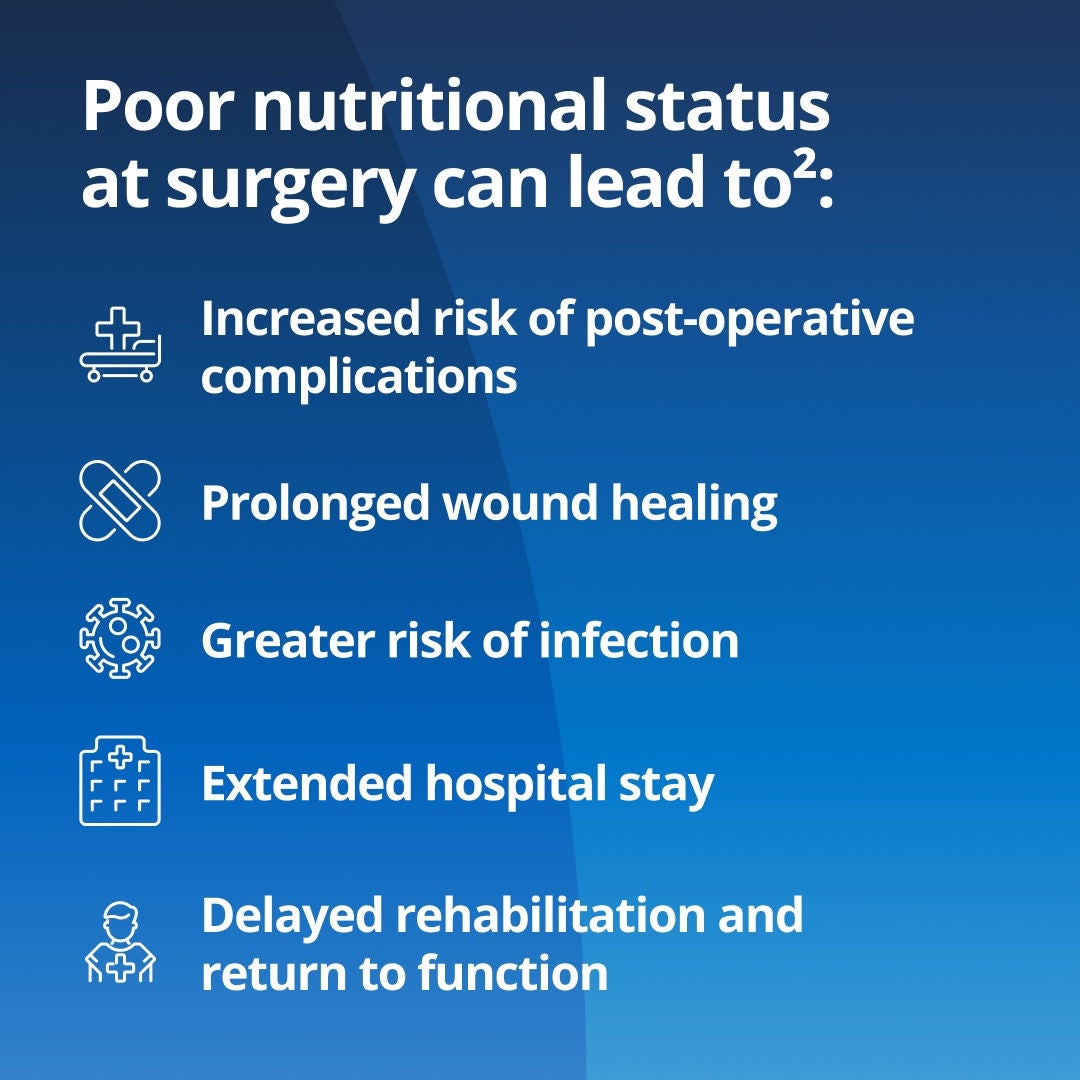
Fresubin explains that poor nutritional status at surgery can lead to increased risk of post-operative complications, prolonged wound healing, greater risk of infection, extended hospital stays, and delayed rehabilitation and return to function.

Building Resilience Before Surgery

Structured preparation ahead of surgery can help patients arrive in the best possible condition. A multimodal prehabilitation approach may include nutritional support, physical activity and strategies to reduce anxiety and stress.

Current guidance recommends screening nutritional status before major surgery and initiating oral nutritional supplements in patients identified as being at nutritional risk. 2,4,5

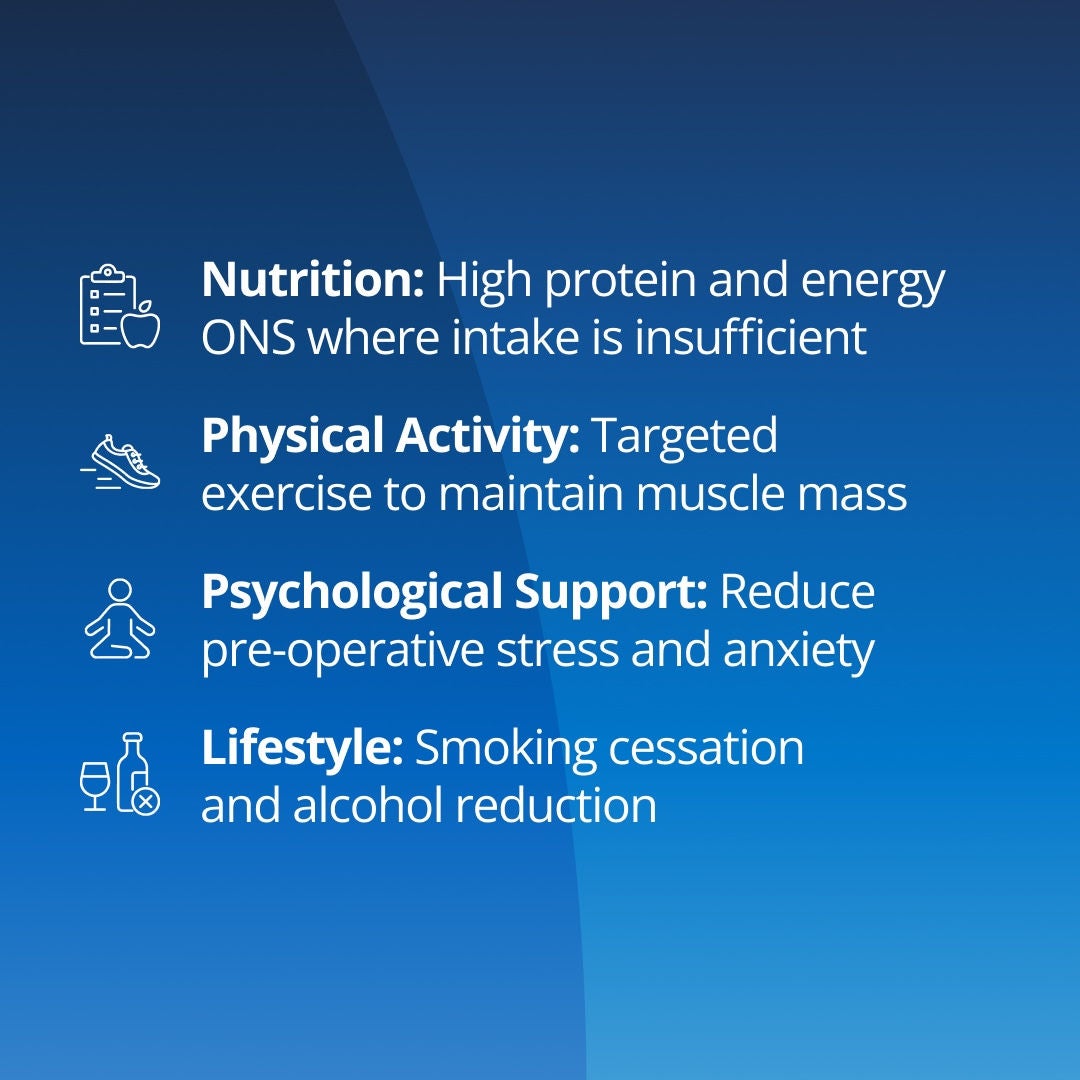
Fresubin explains that surgery recovery can involve nutrition using high protein and energy ONS where intake is insufficient, physical activity with targeted exercise to maintain muscle mass, psychological support to reduce pre-operative stress and anxiety, and lifestyle changes including smoking cessation and alcohol reduction.

Closing the Nutritional Gap Before and After Surgery

Fresubin® oral nutritional supplements range* provide concentrated energy, protein and micronutrients in a manageable volume, helping patients meet their nutritional requirements when their usual dietary intake falls short.

Where oral intake remains insufficient, enteral nutrition can help maintain or improve nutritional status and support quality of life throughout the post-operative period.2,4,5

A woman sits in a wheelchair as she smiles up towards her healthcare professionals who helped her prepare for surgery with Fresubin nutritional supplements before and after her procedure.

Pre-operative Nutrition Support

A man smiles as he sits in a chair recovering well from surgery after using Fresubin's perioperative nutritional supplements to support his recovery.

Back on His Feet After Cardiac Surgery

Patrick, 63, underwent double coronary artery bypass graft surgery, leaving him with significant nutritional deficits and a chest wound that was slow to heal.**

Despite a high-energy hospital diet, he was consuming only 50% of his recommended intake due to reduced appetite and early satiety.

Fresubin 3.2 KCAL Drink was initiated, delivering 400 kcal and 20 g protein in just 125 ml. Within two weeks, his weight had stabilised, his wound was healing well, and he was fully participating in physiotherapy.

**Clinical scenario. For Healthcare Professionals only. To be used under medical supervision. This case does not imply guaranteed outcomes.

A man in a wheelchair smiles as he works with a physiotherapist to recover from surgery whilst his nutritional needs are supported by Fresubin's perioperative supplements.

Product factsheets can be downloaded here.

Fresubin 3.2 KCAL Drink Factsheet

Filename
Fresubin3.2kcalDrink_FS_HCP_Jul26.pdf
Size
987 KB
Format
pdf

Survimed OPD Drink Factsheet

Filename
Survimed_OPDDrink_FS_HCP_Jun2022.pdf
Size
308 KB
Format
pdf

Survimed OPD 1.5 KCAL Drink Factsheet

Filename
Survimed_OPD1.5kcalDrink_FS_HCP_Nov2022.pdf
Size
287 KB
Format
pdf

Survimed OPD Factsheet

Filename
Survimed_OPD_Factsheet_viewPDF_Dec2024.pdf
Size
1 MB
Format
pdf

Survimed OPD HN Factsheet

Filename
SurvimedOPDHN_FS_HCP_Nov22.pdf
Size
1 MB
Format
pdf
*Fresubin products are food for special medical purposes, to be used under medical supervision.


References:

1) Minnella, E.M., et al. JAMA Surg, 2018.

2) Wischmeyer, P.E., et al. Anesth Analg, 2018. 126(6): p. 1883–1895.

3) Gillis, C., et al. Anesthesiology, 2014. 121(5): p. 937–47.

4) Gustafsson UO, Rockall TA, Wexner S, How KY, Emile S, Marchuk A, Fawcett WJ, Sioson M, Riedel B, Chahal R, Balfour A, Baldini G, de Groof EJ, Romagnoli S, Coca-Martinez M, Grass F, Brindle M, Hubner M. Guidelines for perioperative care in elective colorectal surgery: Enhanced Recovery After Surgery (ERAS) Society recommendations 2025. Surgery. 2025 Aug;184:109397. doi: 10.1016/j.surg.2025.109397. Epub 2025 Jun 29. Erratum in: Surgery. 2026 Jul;195:110225. doi: 10.1016/j.surg.2026.110225. PMID: 40783294.

5) Weimann, A., Bezmarevic M, Braga M, Correia MITD, Funk-Debleds P, Gianotti L, Gillis C, Hübner M, Inciong JFB, Jahit MS, Klek S, Kori T, Laviano A, Ljungqvist O, Lobo DN, Segurola CL, Montroni I, Reddy BR, Saur NM, Schweinlin A, Shi HP, Takeuchi H, Waitzberg DL, Wallengren O, Wischmeyer PE, Ysebaert D, Bischoff SC. ESPEN guideline on clinical nutrition in surgery - Update 2025. Clin Nutr. 2025 Oct;53:222-261. doi: 10.1016/j.clnu.2025.08.029. Epub 2025 Sep 3. PMID: 40957230.

For legal reasons, the following information is intended for healthcare professionals only. Please confirm that you are a healthcare professional before continuing.

If you are not a healthcare professional, please select No to be redirected to the appropriate consumer page.