

- The Supportan® Range
Managing Nutritional Risk in Oncology
Malnutrition, sarcopenia and cachexia affect more than 50% of people living with cancer¹⁻³, with consequences including poorer overall survival⁴, reduced quality of life⁵, and longer hospital stays and post-operative complications.⁶˒⁷





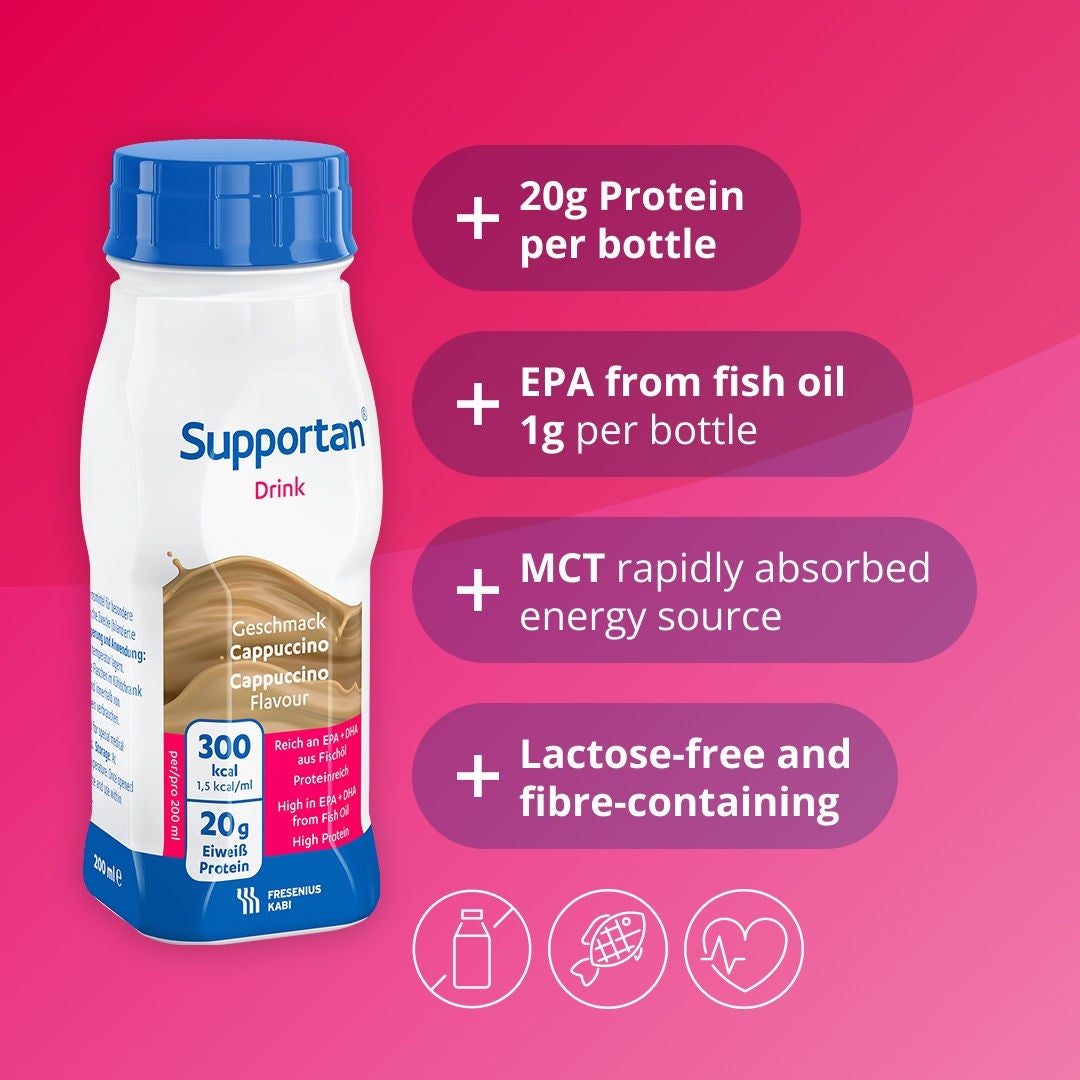


Supportan factsheets can be downloaded here:
Supportan Drink Factsheet
- Filename
- Supportan_Drink_FS_HCP_Jul26.pdf
- Size
- 311 KB
- Format
Supportan Factsheet
- Filename
- Supportan_FS_HCP_Jul26.pdf
- Size
- 1 MB
- Format
References:
1) Caillet P, Liuu E, Raynaud Simon A, Bonnefoy M, Guerin O, Berrut G, Lesourd B, Jeandel C, Ferry M, Rolland Y, Paillaud E. Association between cachexia, chemotherapy and outcomes in older cancer patients: A systematic review. Clin Nutr. 2017 Dec;36(6):1473-1482. doi: 10.1016/j.clnu.2016.12.003. Epub 2016 Dec 18. PMID: 28017447.
2) von Haehling S, Anker MS, Anker SD. Prevalence and clinical impact of cachexia in chronic illness in Europe, USA, and Japan: facts and numbers update 2016. J Cachexia Sarcopenia Muscle. 2016 Dec;7(5):507-509. doi: 10.1002/jcsm.12167. Epub 2016 Nov 2. PMID: 27891294; PMCID: PMC5114624.
3) Hébuterne X, Lemarié E, Michallet M, de Montreuil CB, Schneider SM, Goldwasser F. Prevalence of malnutrition and current use of nutrition support in patients with cancer. JPEN J Parenter Enteral Nutr. 2014 Feb;38(2):196-204. doi: 10.1177/0148607113502674. PMID: 24748626.
4) Zhang X, Tang T, Pang L, Sharma SV, Li R, Nyitray AG, Edwards BJ. Malnutrition and overall survival in older adults with cancer: A systematic review and meta-analysis. J Geriatr Oncol. 2019 Nov;10(6):874-883. doi: 10.1016/j.jgo.2019.03.002. Epub 2019 Mar 24. PMID: 30917937.
5) de Oliveira LC, Abreu GT, Lima LC, Aredes MA, Wiegert EVM. Quality of life and its relation with nutritional status in patients with incurable cancer in palliative care. Support Care Cancer. 2020 Oct;28(10):4971-4978. doi: 10.1007/s00520-020-05339-7. Epub 2020 Feb 7. PMID: 32034514.
6) D'Almeida CA, Peres WAF, de Pinho NB, Martucci RB, Rodrigues VD, Ramalho A. Prevalence of Malnutrition in Older Hospitalised Cancer Patients: A Multicenter and Multiregional Study. J Nutr Health Aging. 2020;24(2):166-171. doi: 10.1007/s12603-020-1309-4. PMID: 32003406; PMCID: PMC12879073.
7) Na BG, Han SS, Cho YA, Wie GA, Kim JY, Lee JM, Lee SD, Kim SH, Park SJ. Nutritional Status of Patients with Cancer: A Prospective Cohort Study of 1,588 Hospitalised Patients. Nutr Cancer. 2018 Nov-Dec;70(8):1228-1236. doi: 10.1080/01635581.2019.1578392. Epub 2019 Mar 22. PMID: 30900926.
8) Daly LE, Power DG, O'Reilly Á, Donnellan P, Cushen SJ, O'Sullivan K, Twomey M, Woodlock DP, Redmond HP, Ryan AM. The impact of body composition parameters on ipilimumab toxicity and survival in patients with metastatic melanoma. Br J Cancer. 2017 Jan;116(3):310-317. doi: 10.1038/bjc.2016.431. Epub 2017 Jan 10. PMID: 28072766; PMCID: PMC5294486.
9) Muscaritoli M, Arends J, Bachmann P, Baracos V, Barthelemy N, Bertz H, Bozzetti F, Hütterer E, Isenring E, Kaasa S, Krznaric Z, Laird B, Larsson M, Laviano A, Mühlebach S, Oldervoll L, Ravasco P, Solheim TS, Strasser F, de van der Schueren M, Preiser JC, Bischoff SC. ESPEN practical guideline: Clinical Nutrition in cancer. Clin Nutr. 2021 May;40(5):2898-2913. doi: 10.1016/j.clnu.2021.02.005. Epub 2021 Mar 15. PMID: 33946039.
10) Arends J, Strasser F, Gonella S, Solheim TS, Madeddu C, Ravasco P, Buonaccorso L, de van der Schueren MAE, Baldwin C, Chasen M, Ripamonti CI. Cancer cachexia in adult patients: ESMO Clinical Practice Guidelines. ESMO Open. 2021 Jun;6(3):100092.