
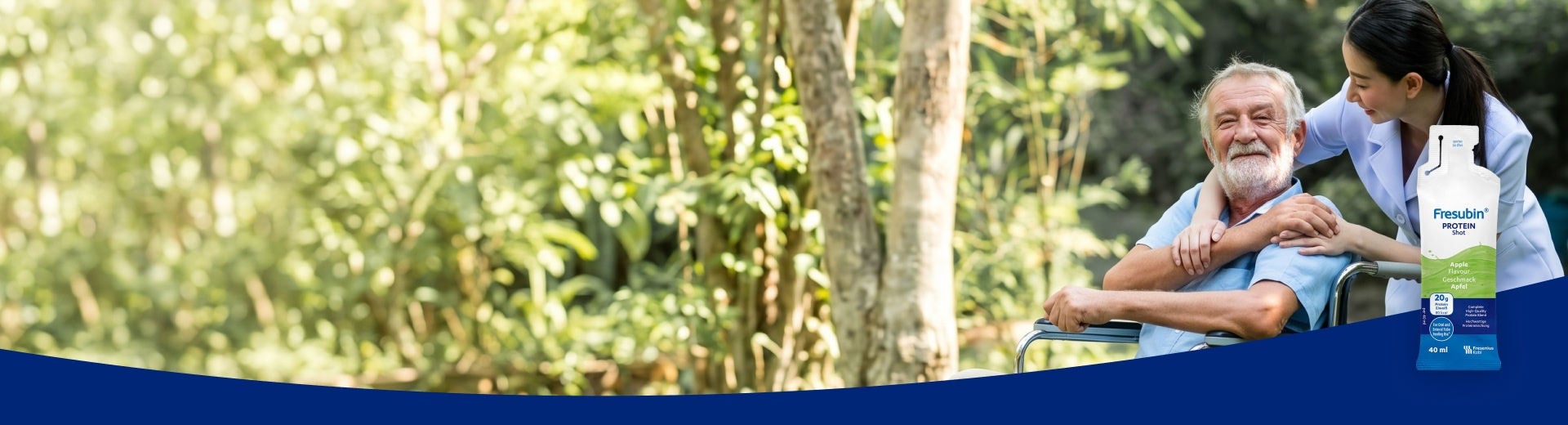
- Fresubin® PROTEIN Shot
Plug Your Patients’ Protein Gap
When increased protein needs can go unmet, patients may see a negative impact on muscle mass, wound healing and immune function.1,2 Fresubin PROTEIN Shot* provides a low-volume option to support protein intake.







Fresubin PROTEIN Shot factsheets can be downloaded here:
Fresubin Protein Shot Factsheet
- Filename
- Fresubin_Protein_Shot_FactSheet_HCP_AUG2025_View.pdf
- Size
- 788 KB
- Format
References
1) Sobotka L, Soeters P. Basics in clinical nutrition: Metabolic response to injury and sepsis. Eur e-J Clin Nutr Metab. 2009;4(1):e1–e3.
2) Gillis C, Carli F. Promoting Perioperative Metabolic and Nutritional Care. Anesthesiology. 2015;123(6):1455-72.
3) FAO/WHO/UNU. Protein and amino acid requirements inhuman nutrition. Report of a joint FAO/WHO/UNU expert consultation (WHO Technical Report Series 935). Geneva; 2007.
4) Montiel-Rojas D, Nilsson A, Santoro A, et al. Fighting Sarcopenia in Ageing European Adults: The Importance of the Amount and Source of Dietary Proteins. Nutrients. 2020 Nov 24;12(12):3601.
5) Orsso CE, Caretero A, Poltronieri TS, et al. Effects ofhigh-protein supplementation during cancer therapy: a systematic review and meta-analysis. Am J Clin Nutr. 2024 Dec;120(6):1311-1324
6) Saleh H, Williamson TK, Passias PG. Perioperative Nutritional Supplementation Decreases Wound Healing Complications Following Elective Lumbar Spine Surgery: A Randomized Controlled Trial. Spine (Phila Pa 1976). 2023 Mar 15;48(6):376-383
7) Pu H, Heighes PT, Simpson F, et al. Early oral protein-containing diets following elective lower gastrointestinal tract surgery in adults: a meta-analysis of randomized clinical trials. Perioper Med (Lond). 2021 Mar 23;10(1):10.
8) Yeung SE, Hilkewich L, Gillis C, Heine JA, Fenton TR. Protein intakes are associated with reduced length of stay: a comparison between Enhanced Recovery After Surgery (ERAS) and conventional care after elective colorectal surgery. Am J Clin Nutr. 2017 Jul;106(1):44-51.
9) Im K et al. Nutrients. 2023 Nov 5;15(21):4684.
10) Bauer J, Biolo G, Cederholm T, et al. Evidence-based recommendations for optimal dietary protein intake in older people: a position paper from the PROT-AGE Study Group. J Am Med Dir Assoc. 2013;14(8):542-
11) Deutz NE, et al. Nutritional recommendations for the management of sarcopenia. J Am Med Dir Assoc. 2010;11(6):391-6. 5.
12) Deutz NE, Bauer JM, Barazzoni R, et al. Protein intake and exercise for optimal muscle function with aging: recommendations from the ESPEN Expert Group. Clinical nutrition (Edinburgh, Scotland). 2014;33(6):929-36.
13) Volkert D, Beck AM, Cederholm T, et al. ESPEN practical guideline: Clinical nutrition and hydration in geriatrics. Clinical nutrition (Edinburgh, Scotland). 2022;41(4):958-89.
14) Hengeveld LM, Boer JMA, Gaudreau P, et al. Prevalence of protein intake below recommended in community-dwelling older adults: a meta-analysis across cohorts from the PROMISS consortium. J Cachexia Sarcopenia Muscle. 2020;11(5):1212-22.5(1):49-58.
15) Muscaritoli M, Arends J, Bachmann P, et al. ESPEN practical guideline: Clinical Nutrition in cancer. Clin Nutr. 2021 May;40(5):2898-2913.
16) Arends J, Baracos V, Bertz H, et al. ESPEN expert group recommendations for action against cancer-related malnutrition. Clin Nutr. 2017 Oct;36(5):1187-1196.
17) Arends J, Strasser F, Gonella S, et al. ESMO Guidelines Committee. Electronic address: clinicalguidelines@esmo.org. Cancer cachexia in adult patients: ESMO Clinical Practice Guidelines☆. ESMO Open. 2021 Jun;6(3):100092.
18) Bauer J, Morley JE, Schols AMWJ, et al. Sarcopenia: A Time for Action. An SCWD Position Paper. J Cachexia Sarcopenia Muscle. 2019 Oct;10(5):956-961
19) Stobäus N, Müller MJ, Küpferling S, et al. Protein Intake Predicts Cancer-Related Fatigue and Increased Mortality in Patients with Advanced Tumor Disease Undergoing Chemotherapy. Nutr Cancer. 2015;67(5):818-24
20) Heber D, Greenway FL, Kaplan LM, et al; Endocrine Society. Endocrine and nutritional management of the post-bariatric surgery patient: an Endocrine Society Clinical Practice Guideline. J Clin Endocrinol Metab. 2010 Nov;95(11):4823-43.
21) Busetto L, Dicker D, Azran C, et al. Practical Recommendations of the Obesity Management Task Force of the European Association for the Study of Obesity for the Post-Bariatric Surgery Medical Management. Obes Facts. 2017;10(6):597-632
22) Stenberg E, Dos Reis Falcão LF, O'Kane M, et al. Guidelines for Perioperative Care in Bariatric Surgery: Enhanced Recovery After Surgery (ERAS) Society Recommendations: A 2021 Update. World J Surg. 2022 Apr;46(4):729-751
23) Bischoff SC, Barazzoni R, Busetto L, et al. European guideline on obesity care in patients with gastrointestinal and liver diseases - Joint ESPEN/UEG guideline. Clin Nutr. 2022 Oct;41(10):2364-2405 17.
24) Mechanick JI, Apovian C, Brethauer S, et al. Clinical practice guidelines for the perioperative nutrition, metabolic, and nonsurgical support of patients undergoing bariatric procedures - 2019 update: cosponsored by american association of clinical endocrinologists/american college of endocrinology, the obesity society, american society for metabolic & bariatric surgery, obesity medicine association, and american society of anesthesiologists - executive summary. Endocr Pract. 2019 Dec;25(12):1346-1359.
25) Andreu A, Moizé V, Rodríguez L, et al. Protein intake, body composition, and protein status following bariatric surgery. Obes Surg. 2010 Nov;20(11):1509-15.
26) Singer P, Blaser AR, Berger MM, et al. ESPEN practical and partially revised guideline: Clinical nutrition in the intensive care unit. Clinical nutrition 2023, 43, pp.1671-1869
27) van Zanten ARH, De Waele E, Wischmeyer PE. Nutrition therapy and critical illness: practical guidance for the ICU, post-ICU, and long-term convalescence phases. Crit Care. 2019 Nov 21;23(1):368.
28) Heyland DK, Dhaliwal R, Wang M, Day AG. The prevalence of iatrogenic underfeeding in the nutritionally 'at-risk' critically ill patient: Results of an international, multicenter, prospective study. Clin Nutr. 2015 Aug;34(4):659-66.
29) Rosseel Z, Cortoos PJ, Leemans L, et al. Energy and protein nutrition adequacy in general wards among intensive care unit survivors: A systematic review and meta-analysis. JPEN J Parenter Enteral Nutr. 2025 Jan;49(1):18-32.
30) Park Y, Choi JE, Hwang HS. Protein supplementation improves muscle mass and physical performance in undernourished prefrail and frail elderly subjects: a randomized, double-blind, placebo-controlled trial. Am J Clin Nutr. 2018 Nov 1;108(5):1026-1033. 53.
31) Orsso CE, Caretero A, Poltronieri TS, et al. Effects ofhigh-protein supplementation during cancer therapy: a systematic review and meta-analysis. Am J Clin Nutr. 2024 Dec;120(6):1311-1324
32) Lee SK, Posthauer ME, Dorner B, et al. Pressure ulcer healing with a concentrated, fortified, collagen protein hydrolysate supplement: a randomized controlled trial. Adv Skin Wound Care. 2006 Mar;19(2):92-6
33) Bagheri Miyab K, Alipoor E, Vaghardoost R, et al. The effect of a hydrolyzed collagen-based supplement on wound healing in patients with burn: A randomized double-blind pilot clinical trial. Burns. 2020 Feb;46(1):156-163.
34) Alipoor E, Jazayeri S, Dahmardehei M, et al. Effect of a collagen-enriched beverage with or without omega-3 fatty acids on wound healing, metabolic biomarkers, and adipokines in patients with major burns. Clin Nutr. 2023Mar;42(3):298-308.
*For the dietary management of patients with or at risk of disease related malnutrition, in particular for patients with increased energy needs or low volume tolerance. Food for special medical purposes, use under medical supervision only.