Formulated for the Nutritional Demands of Recovery

Reconvan* brings together a targeted combination of arginine, glutamine and omega-3 fatty acids from fish oil, each carefully chosen for their specific relevance to the physiological challenges that arise following major surgery or trauma.


Addressing the Nutritional Complexity of Post-Surgical Patients

Reconvan is a nutritionally complete formula with a high protein content (22 energy%), formulated with hydrolysed wheat protein. It combines increased glutamine and arginine, EPA and DHA from fish oil and MCT. It is clinically free from lactose and free from fibre. 

Suitable as a sole source of nutrition under medical supervision, with dosage determined by the responsible clinician based on individual patients' needs.

A patient rests in a hospital bed as nutritional needs are supported by Reconvan, a nutritionally complete, high-protein tube feed formulated with hydrolysed wheat protein.

Practical Administration Across Clinical Settings

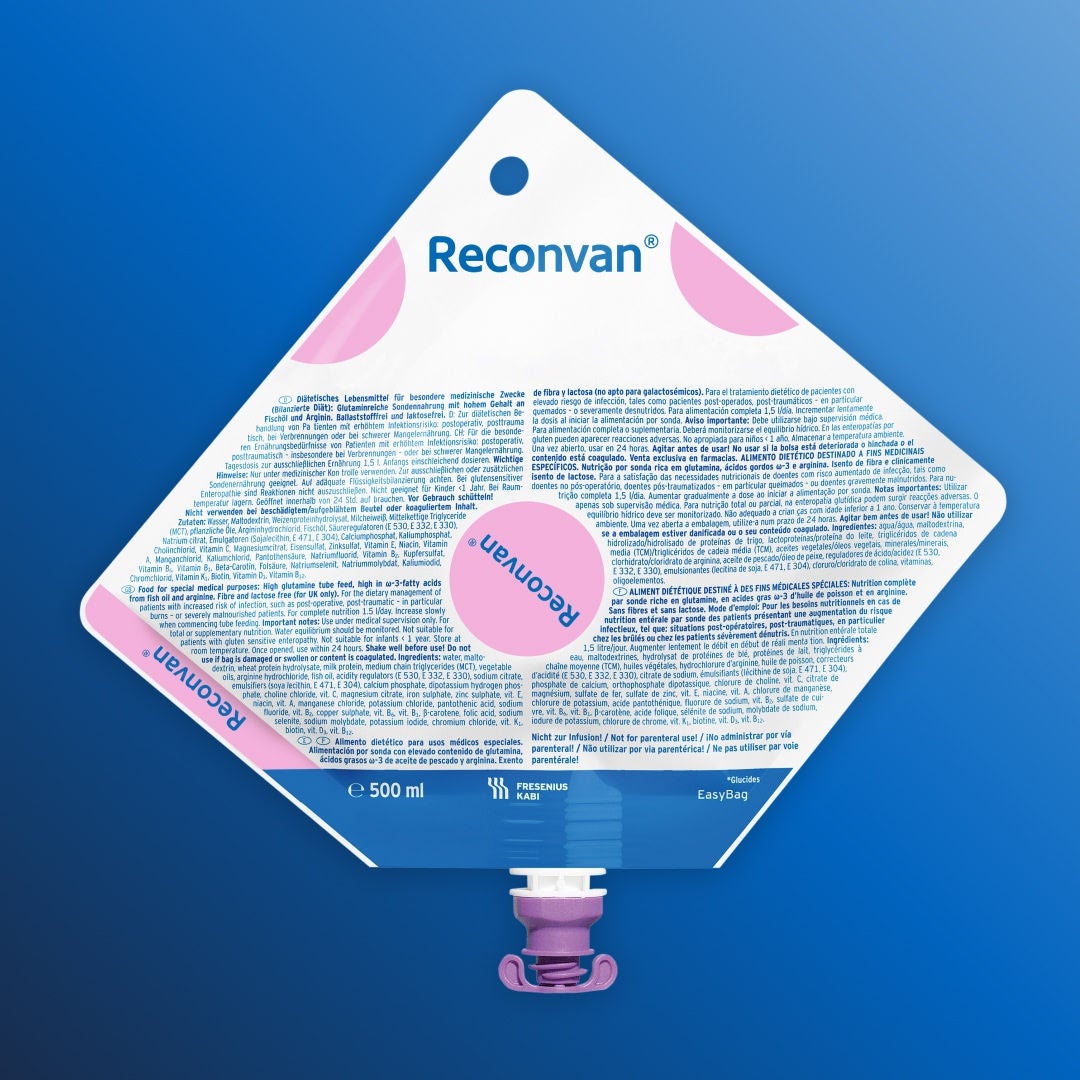
Reconvan comes as a ready-to-use tube feed in a 500 ml EasyBag.

Tube Size:
• Pump-assisted feeding: ≥ CH 5
• Gravity feeding: ≥ CH 12

Complete Nutrition: ≥ 1500 ml (1500 kcal)/day

Dosage: Individual requirements vary; quantity and schedule to be determined by the responsible healthcare professional based on clinical assessment.

Reconvan high-protein tube feed in a 500 ml EasyBag, formulated with arginine, glutamine, EPA and DHA from fish oil and MCT.

Reconvan factsheets can be downloaded here:

Reconvan Factsheet

Filename
Reconvan_FS_HCR_Jun22.pdf
Size
1 MB
Format
pdf
*Reconvan is a food for special medical purposes, to be used under medical supervision. For the dietary management of patients with or at risk of malnutrition. Suitable as sole source of nutrition Not recommended for patients with severe SIRS or sepsis. Not suitable for children under 3 years or patients with galactosaemia. Use with caution in children under 6 years. Not for parenteral (I.V.) use. For Healthcare Professionals only.


References:

1. Klek S et al. Clin Nutr. 2011;30(3):282-8. 
2. Marik PE and Zaloga GP. JPEN J Parenter Enteral Nutr. 2010;34(4):378-86
3. Lorenz KJ et al. GMS Interdiscip Plast Reconstr Surg DGPW. 2015;4:Doc15.
4. Zhou YP et al. JPEN J Parenter Enteral Nutr. 2003;27(4):241-5. 
5. Peng X et al.  Burns. 2004;30(2):135-9. 
6. Babayan VK. Lipids. 1987;22(6):417-20.  

For legal reasons, the following information is intended for healthcare professionals only. Please confirm that you are a healthcare professional before continuing.

If you are not a healthcare professional, please select No to be redirected to the appropriate consumer page.